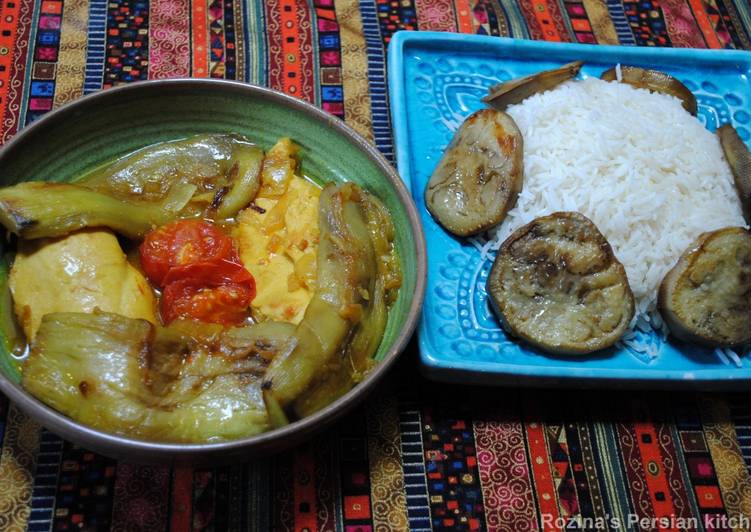
Hello everybody, I hope you’re having an incredible day today. Today, I’m gonna show you how to prepare a distinctive dish, persian eggplants stew with chicken. One of my favorites. For mine, I will make it a bit unique. This will be really delicious.
Persian Eggplants Stew with Chicken is one of the most favored of current trending foods on earth. It’s simple, it’s fast, it tastes yummy. It’s appreciated by millions every day. They are fine and they look wonderful. Persian Eggplants Stew with Chicken is something that I’ve loved my whole life.
Khoresh bademjan or Khoresht or Khoresh-e bademjan (my Farsi is not great - but I can say "thank you" which is "mersi" - ok that's a bit easy - and "khubi" which is "whattup?") eggplant and tomato stew is a traditional Persian dish that can be made with chicken, lamb or beef. Persian Eggplant Stew. this link is to an external site that may or may not meet accessibility. Gheymeh Bademjan (eggplant lentil stew) is one of my all time favorite dishes. A Dutch oven (or Le Creuset) works great for Persian stews but you can use a pot as well.
To begin with this recipe, we have to prepare a few ingredients. You can have persian eggplants stew with chicken using 9 ingredients and 18 steps. Here is how you cook that.
The ingredients needed to make Persian Eggplants Stew with Chicken:
- Make ready 2 eggplants
- Prepare 2 onions cut into lengthwise and fry
- Prepare 2 cloves garlic
- Get 2 chicken breast or legs (but you can choose beef or lamb meat as well)
- Make ready 1-2 medium size tomatoes cut into half
- Make ready to taste Salt-red chilli powder
- Prepare 1 Tbsp saffron water (if not available use turmeric)
- Take 1 tbsp lemon or lime juice
- Take Vegetable oil
I hated aubergines when I was a child and refused to touch any dish with Stews (khoresht/khoresh/ghalyeh) are the equivalent of curries in Persian cuisine. They are usually made with lamb, beef, chicken, prawns or fish and. Persian Eggplant Stew or Khoresh Bademjan is a very popular Parsi cuisine recipe. To begin the preparation of Persian Eggplant Stew Recipe, first peel and cube the eggplant and place in a colander.
Steps to make Persian Eggplants Stew with Chicken:
- Peel skin off egg plants. Cut into lengthwise or circle shapes. Put some salt on cut eggplants to excess moisture and the bitterness. By this way, eggplants will fry faster and would not soak too much oil.
- Before frying the eggplants wrap the eggplants in a kitchen towel and pressing which removes all salty water.
- Fry the eggplants until both sides are nicely golden.
- Fry other chopped onion. Then fry the cooked chicken breasts for 3-4 minutes..
- In a pot with water, add one of chopped onion, garlic and chicken. Leave it to cook. if there is leftover chicken juice add it to the stew afterwards.
- Now in a pot with fried chicken, add eggplants, fried onions, spices,tomatoes, saffron water, lemon juice. Add leftover chicken juice and cook for 20 minutes over a low heat. - Once your delicious eggplant stew is ready, serve it with rice or flat bread. Enjoy it
- Here i have made eggplant stew with beef.
- Ingredients
- Ingredients
Persian Eggplant Stew or Khoresh Bademjan is a very popular Parsi cuisine recipe. To begin the preparation of Persian Eggplant Stew Recipe, first peel and cube the eggplant and place in a colander. Eggplant recipes with High Quality Videos, halim bademjan recipe, kashk bademjan recipe, mirza ghasemi recipe, mosama recipe, eggplant frittata, tas Chicken Eggplant Tahdig. Combine the eggplant and tomato purée with the chicken mixture. There are plenty of eggplant dishes and side dishes in Persian cuisine such as Eggplant Dip (Kashke Bademjan) or Stuffed Eggplant, but one of the most popular one in Iran is Khoresh Bademjan or eggplant stew.
So that is going to wrap this up with this special food persian eggplants stew with chicken recipe. Thanks so much for your time. I am confident you will make this at home. There is gonna be interesting food in home recipes coming up. Don’t forget to bookmark this page in your browser, and share it to your loved ones, colleague and friends. Thanks again for reading. Go on get cooking!